

School clubs, sports, and internships are fun for kids and adults, but they are also powerful engines for learning other life and leadership skills. When young people are given a meaningful role in their activities, they learn conflict resolution, communication, and responsibility.
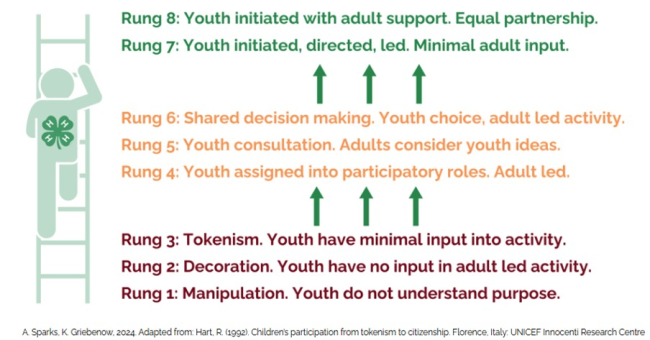
How much “say” do youth have in your programs? Hart’s Ladder of Participation (see graphic) is a quick way to assess this:
Noticing when on the bottom rungs (Non-Participation):
- Manipulation & Decoration: Using youth as “props” for adult ideas without giving them understanding or influence.
- Tokenism: Asking for opinions but ignoring them when making decisions.
Aim for the higher rungs (Increasing Degrees of Participation):
- Informed: Youth are assigned tasks but fully understand the purpose.
- Shared Decisions: Whether the project is started by adults or kids, the decision-making power is shared.
- Youth-Directed: Young people initiate projects and lead the way, with adults acting as supportive mentors.
The Takeaway: Not every activity needs to be at the top rung—safety and maturity always come first. However, simply offering a few more choices can make a difference. It creates deeper learning for the kids and actually lightens the decision-making load for the adults!
Want to move up the ladder? If you’d like to brainstorm how to apply this to your organization, contact Diana at Sheboygan County Extension. Email: Diana.Hammer@wisc.edu Phone: 920-459-5916*Thanks to Outagamie County Extension’s Alicia Schroeder-Haag for the Hart’s Ladder explanation & edits from Google Gemini